What Is Amazon FBM? Pros, Cons, and Everything You Need to

Choosing how your orders get packed and delivered is one of the biggest decisions an Amazon seller makes. Amazon FBM (Fulfilled by Merchant) lets you keep that whole process in your own hands, from storage to shipping to customer service. In this guide we explain what Amazon FBM is, how it works, its pros and cons, how it compares with FBA, and who it suits best.
In this guide
What Is Amazon FBM?
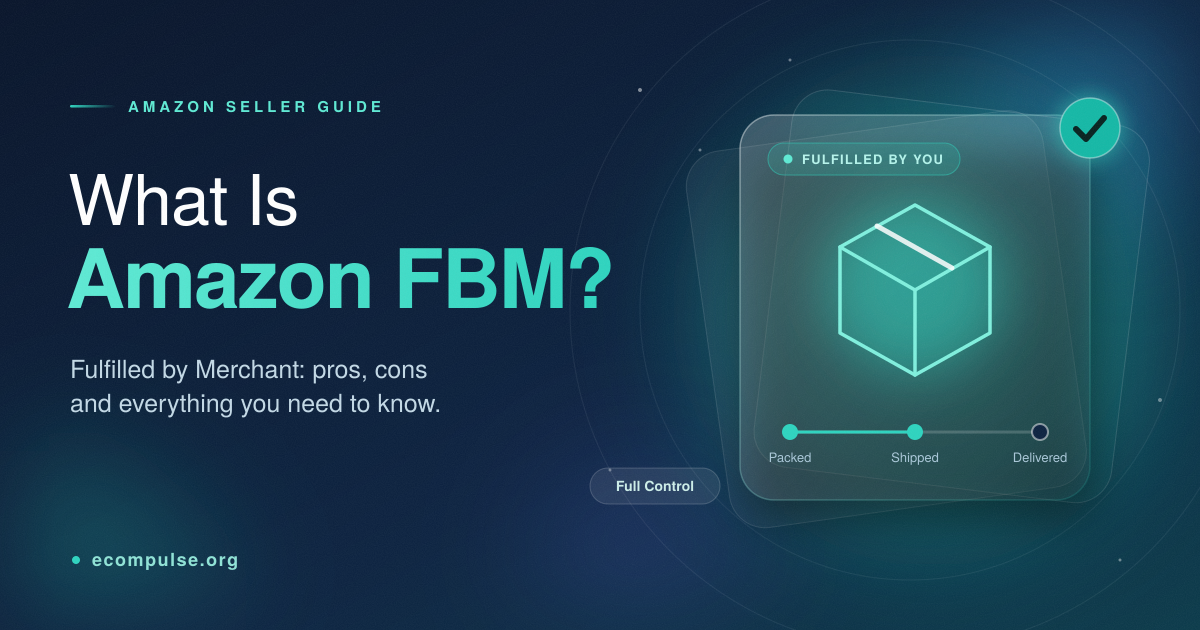
Amazon FBM stands for Fulfilled by Merchant. It is a selling model where you, the seller, store your products, pack the orders, ship them to customers, and handle returns and customer questions yourself. Amazon still provides the marketplace, the traffic, and the payment system, but the physical fulfillment is on you.
It is the direct alternative to FBA (Fulfillment by Amazon), where Amazon stores your inventory in its warehouses and does the picking, packing, and shipping for you.
How Amazon FBM Works
The process is simple once your listing is live:
- List your product on Amazon and choose “Merchant Fulfilled” as the fulfillment method.
- A customer places an order and Amazon notifies you in Seller Central.
- You pack the item from your own stock, your warehouse, or a third-party logistics (3PL) partner.
- You ship it with a carrier of your choice and upload valid tracking information.
- You manage after-sales, including customer messages, returns, and refunds.
- Amazon pays you after the order is delivered, minus its selling fees.
Quick note: With FBM, shipping speed, packaging quality, and customer service all directly shape your seller metrics and your account health.
Pros of Amazon FBM
Why sellers choose FBM
- Lower fulfillment costs: no FBA pick-and-pack or storage fees.
- Full inventory control: your stock stays with you, so you can inspect and re-pack anytime.
- Great for large or slow-moving items: avoid FBA storage costs on products that sit for months.
- Easy to start: test a product without sending bulk inventory to Amazon.
- Brand experience: add custom inserts, thank-you cards, and premium packaging.
- Flexible shipping: choose carriers and shipping methods that fit your margins.
Quick benefits at a glance
- Lower upfront cost and risk
- No long-term storage fee worries
- Direct control over quality and returns
- Easy to run alongside FBA (hybrid)
- Useful backup when FBA stock runs out
Cons of Amazon FBM
- No automatic Prime badge: standard FBM listings do not get the Prime logo, which can hurt conversions because many shoppers filter by Prime.
- Harder to win the Buy Box: FBA and Prime-eligible offers often have an advantage, especially when prices are close.
- More work for you: packing, shipping, tracking, and returns take real time as order volume grows.
- Customer service is yours: you must reply to buyer messages promptly and handle returns and refunds.
- Strict performance metrics: late shipments, cancellations, and invalid tracking can put your account at risk.
- Scaling is harder: without a warehouse team or a 3PL, growth quickly becomes a bottleneck.
Amazon FBM vs FBA: Quick Comparison
| Factor | FBM | FBA |
|---|---|---|
| Who ships orders | You (or your 3PL) | Amazon |
| Prime badge | Not automatic | Yes, eligible |
| Buy Box chances | Lower in many cases | Generally higher |
| Storage | Your own space | Amazon fulfillment centers |
| Fees | Selling fees plus your shipping costs | Selling fees plus FBA fulfillment and storage fees |
| Customer service | Handled by you | Largely handled by Amazon |
| Control | High | Lower |
| Best for | Large, fragile, custom, or slow-selling items | Fast-moving, small, standard-size products |
The right choice depends on your product, margins, and capacity. Many successful sellers use a hybrid approach: FBA for best sellers and FBM for bulky, low-volume, or backup inventory.
What Is Seller Fulfilled Prime?
Seller Fulfilled Prime (SFP) is a program that lets qualified FBM sellers offer Prime shipping from their own warehouse. You get the Prime badge while keeping control of fulfillment, but you must meet Amazon’s strict delivery speed and performance requirements, and approval usually involves a trial period. It is a strong option for established sellers with reliable logistics.
Who Should Use Amazon FBM?
FBM tends to work well if you:
- Sell oversized, heavy, or fragile products that are expensive to store with FBA.
- Have low-volume or slow-moving inventory.
- Offer custom or made-to-order items.
- Want to test new products with minimal risk.
- Already run a warehouse or 3PL and have shipping experience.
If you sell high-volume, small, standard-size products and want Prime visibility with less daily work, FBA is usually the better fit.
How to Start Selling with Amazon FBM
- Create a Seller Central account and complete identity and tax verification.
- Research your product and check category requirements and restrictions.
- Create your listing with a keyword-rich title, clear bullet points, and quality images.
- Set up shipping templates with realistic handling times and rates.
- Prepare your packaging and pick a reliable carrier with tracking.
- Ship on time, every time and upload tracking promptly.
- Monitor your metrics in the Account Health dashboard.
Tips to Succeed with Amazon FBM
- Ship fast: quick, reliable delivery builds trust and protects your metrics.
- Always use tracking: valid tracking is essential for account health and buyer confidence.
- Reply within 24 hours: fast customer service improves reviews and reduces disputes.
- Invest in packaging: damaged items lead to returns and bad feedback.
- Price smartly: factor in shipping, packaging, and labor so your margins stay healthy.
- Consider a 3PL: outsource storage and shipping once order volume grows.
- Keep inventory accurate: never oversell, since cancellations hurt your account.
Frequently Asked Questions About Amazon FBM
What does FBM stand for on Amazon?
FBM stands for Fulfilled by Merchant. It means the seller stores, packs, and ships the products and handles customer service instead of Amazon.
Is Amazon FBM better than FBA?
Neither is better in every case. FBM offers lower fulfillment costs and more control, while FBA offers Prime eligibility, stronger Buy Box chances, and less daily work. The best choice depends on your product and business model.
Can I use FBM and FBA together?
Yes. Many sellers use a hybrid model, using FBA for fast-moving products and FBM for bulky, slow-selling, or backup inventory.
Do FBM products get the Prime badge?
Not automatically. To offer Prime on merchant-fulfilled orders, you need to qualify for Seller Fulfilled Prime and meet its performance standards.
Is Amazon FBM good for beginners?
It can be, since it needs less upfront investment and lets you test products with low risk. However, you must be ready to handle shipping, returns, and customer service on time.
Can I use a 3PL with Amazon FBM?
Yes. Many FBM sellers use a third-party logistics provider to store inventory and ship orders, which helps them scale without managing a warehouse themselves.
Final Thoughts
Amazon FBM gives you control, flexibility, and lower fulfillment costs, but it also demands consistent shipping and strong customer service. For large, specialized, or slow-moving products it can be very profitable. For fast-moving products, FBA or a hybrid model may deliver better visibility and growth. The key is choosing the model that matches your product, budget, and operations.
Need Help Growing Your Amazon Business?
EcomPulse helps brands with Amazon account management, listing optimization, and growth strategy, so you can pick the right fulfillment model and scale with confidence.
Talk to EcomPulse