
Amazon Blocked Meta Muse: Here’s Why

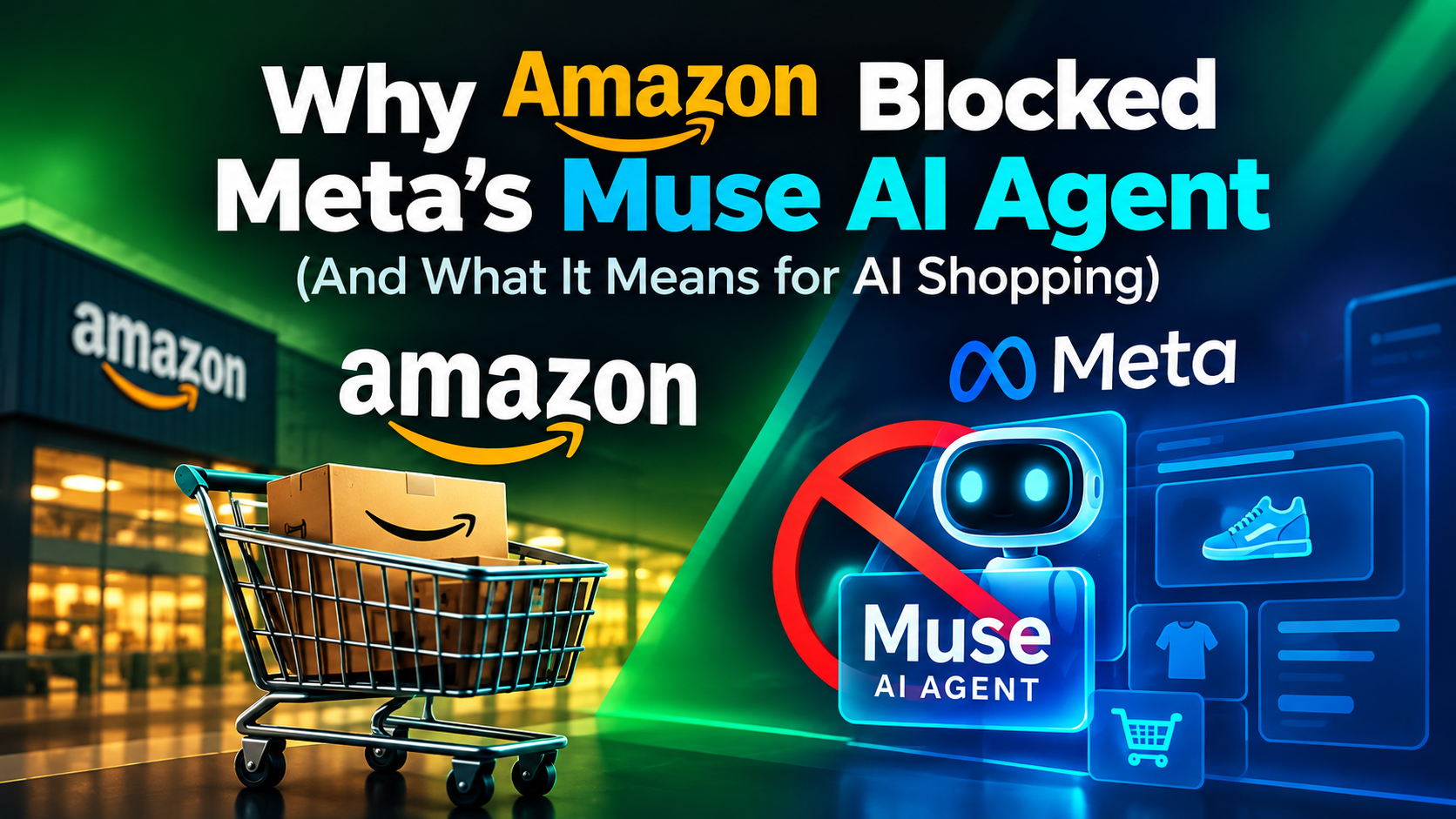
Picture this. You ask your AI assistant to reorder a phone charger, and instead of a checkout page you get a pop-up saying the assistant isn’t welcome. That’s what happened to people using Meta’s new agent in September 2026, when Amazon blocked Meta Muse from its store. It looks like a spat between two tech giants. It’s really a fight over who sits between a shopper and the buy button. Here’s what happened, what each side says, and what to watch next.
Last updated: September 2026
Quick Answer: Amazon blocked Meta Muse from shopping on Amazon.com because the AI agent allegedly arrived without notice, doesn’t say it’s an AI agent while browsing, and appears to store customer credentials. Meta disputes the credentials claim. The dispute is really about who controls the customer relationship when software does the buying.
Table of Contents
- What is Meta Muse, the AI agent Amazon blocked?
- Why Amazon blocked Meta Muse: what did Amazon say?
- What does Meta say now that Amazon blocked Meta Muse?
- Is this the first time Amazon has blocked an AI agent?
- How are other retailers handling AI shopping agents?
- What does it mean for AI shopping now that Amazon blocked Meta Muse?
- What should shoppers and sellers do now?
- Common myths about how Amazon blocked Meta Muse
- Key Takeaways
- FAQ
What is Meta Muse, the AI agent Amazon blocked?
Meta Muse is a personal AI agent that carries out everyday online tasks for you, such as shopping and booking appointments. An AI agent is software that takes actions on your behalf, not just answers questions. Meta launched Muse on September 8, 2026.
According to GeekWire, Muse is free with paid subscription tiers, and it’s available on iOS, Android, muse.ai and WhatsApp. The detail that matters most is how it gets things done. If a service has a public API, Muse connects using credentials the user provides. If there’s no API, Meta says the agent can use the service through a browser the way you would.
That second route is where the trouble starts. A browser session that mimics a person looks like a normal customer visit, which is why a store may want to know when it’s really a bot. Keep that browser route in mind, because it sits at the center of why Amazon blocked Meta Muse.
Why Amazon blocked Meta Muse: what did Amazon say?
Amazon blocked Meta Muse because it says the agent visited its store without notice, doesn’t identify itself as an AI agent, and appears to capture customer credentials. Amazon asked Meta to remove the store from Muse, Meta declined, and the block began on Sunday night, September 20, 2026.
Bloomberg reported that once Amazon blocked Meta Muse, people using it on Amazon started seeing pop-ups saying the use violates Amazon’s terms. Amazon has given four main reasons, and there’s a fifth worth thinking about.
Reason 1: No advance notice. Amazon says Meta never told it that Muse would access the store. From Amazon’s side, a third party started handling its customers’ orders without a heads-up. Most businesses would object to that.
Reason 2: The agent doesn’t say what it is. Amazon says Muse doesn’t identify itself when it browses. Without a label, Amazon can’t tell an agent from a person, so it can’t apply its own rules for automated traffic. It’s the same complaint Amazon made in earlier disputes.
Reason 3: Worry about stored credentials. Amazon says the agent appears to capture and store customer credentials, which it says could create privacy and security risks. Notice the word “appears”. Amazon hasn’t published technical proof, and Meta disagrees (more on that below).
Reason 4: Lost personalization. Amazon argues that when an agent shops for a customer, it bypasses the personalization Amazon has built. Shoppers may see products that ignore their browsing history or Amazon’s recommendations. Amazon also says it expects agents to work transparently and let customers opt out.
The reason Amazon hasn’t stated. Critics have long argued that advertising and product placement are part of the motive. Perplexity made that claim during its earlier dispute with Amazon. Amazon hasn’t said this about Muse, so I’d treat it as a fair question, not a proven fact.
What does Meta say now that Amazon blocked Meta Muse?
Meta says Muse has no visibility into people’s passwords or payment methods. Its launch post says logins go into secure storage that the agent can use without seeing them. Amazon says the opposite, so the two accounts currently conflict.
Are they really opposed? Not necessarily. One analysis notes the two statements aren’t necessarily contradictory, and that settling the question would take technical detail neither company has published. An agent can use a login without a human-readable copy, yet a system could still hold that login somewhere Amazon considers storage.
Meta has also described controls meant to keep credentials isolated and to ask for approval before sensitive actions like a purchase. So when Amazon blocked Meta Muse over credentials, it made a claim it hasn’t fully backed with technical detail. My honest read: until one side shows its work, treat the credentials question as unresolved. Don’t assume either company is simply right.
Is this the first time Amazon has blocked an AI agent?
No. In November 2025, Amazon sued Perplexity over its Comet browser agent, and it has restricted OpenAI’s, Google’s and Anthropic’s bots from crawling its website, according to Forbes. When Amazon blocked Meta Muse, it added another case to a clear pattern.
The Perplexity Comet dispute had the same core argument. Amazon said Comet broke its terms by not identifying itself as an agent. Perplexity argued that an agent acting for a user has the same permissions as that user. Nobody has settled which view is right.
Two differences stand out this time. First, Amazon relied on its Conditions of Use rather than the Computer Fraud and Abuse Act, as The New Stack points out. Second, Amazon isn’t anti-agent in general. It launched its own agent, Alexa for Shopping, in May.
Some commentators call that a double standard. One report argues that Amazon demands consent from outside agents while its own Buy for Me agent reached third-party sites without permission. Treat that as one outlet’s argument, not an established finding.
How are other retailers handling AI shopping agents?
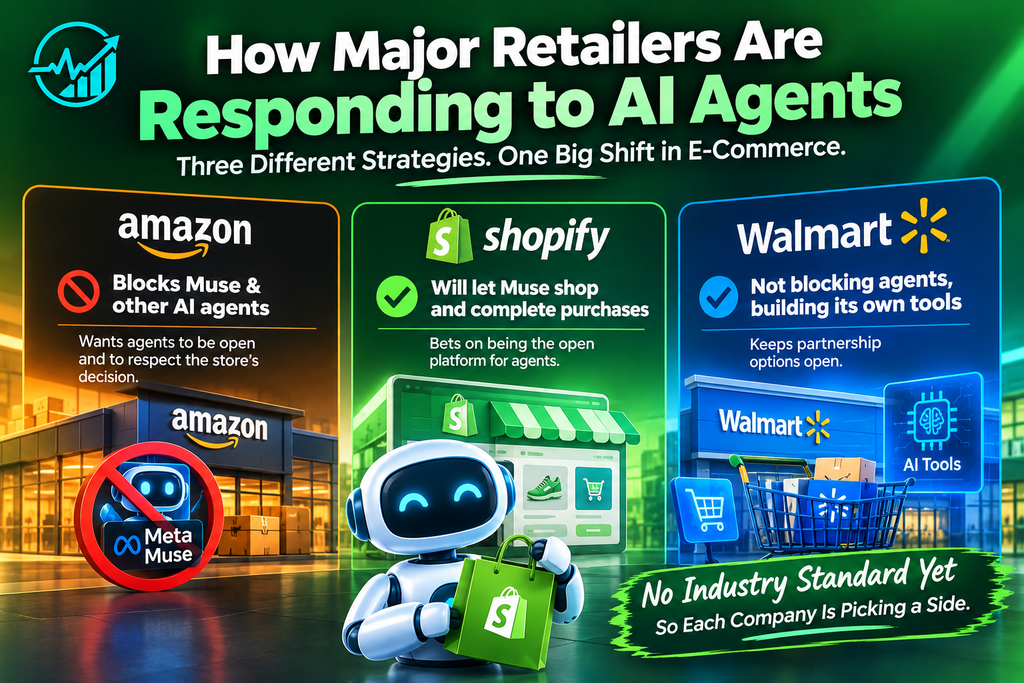
Retailers are split. Amazon blocks Muse, Shopify has opened its stores to it, and Walmart says it isn’t blocking agents while it builds its own tools. There’s no industry standard yet, so each company is picking a side.
| Retailer | Stance on outside AI agents | What it signals |
|---|---|---|
| Amazon | Blocks Muse and has restricted other agents and crawlers | Wants agents to be open and to respect the store’s decision |
| Shopify | Will let Meta’s agent shop and complete purchases on all storefronts | Bets on being the open platform for agents |
| Walmart | Not blocking agents, building its own tools | Keeps partnership options open |
Shopify CEO Tobias Lutke said the company would let Muse shop and complete purchases across its storefronts, per Forbes. Walmart’s position comes from a report citing The Information, which says the company wants to keep its technology open to partnerships. In short, Amazon blocked Meta Muse while Shopify let it in, and that split may not close soon. These stances can change fast, so check for updates
.
What does it mean for AI shopping now that Amazon blocked Meta Muse?
The fact that Amazon blocked Meta Muse shows that AI shopping will depend on permission, identity and trust, not just clever software. Whoever controls the account, the data and the recommendations will set the rules. Shoppers may find their AI helper works on some stores and not others.
Agent identification is becoming the main issue. If a store can’t tell a bot from a person, it can’t apply fair rules. Payment networks are already working on standards for identifying agents. Expect this to become normal, a bit like how websites learned to handle search crawlers.
Shoppers may get a patchy experience. Today’s picture is uneven. One store blocks an agent, another welcomes it. For you as a buyer, that means “just ask AI to buy it” will work in some places and hit a wall in others, at least for now.
Sellers face a new discovery channel. A recent survey cited by Forbes found that 42% of consumers used an AI tool while shopping in the past month. Some analysts say retailers that don’t adapt could vanish from agent results. That’s a forecast, not a fact, but it’s worth taking seriously if you sell online.
What should shoppers and sellers do now?
Shoppers should check what access an AI agent asks for and keep purchase approvals switched on. Sellers should decide their stance on agents, state it clearly and make product data easy for machines to read. Neither group needs to panic.
For shoppers
- Read the permissions. See exactly which accounts the agent can log into.
- Keep approvals on. Make sure the agent asks before it buys.
- Use unique passwords. If you share a login with any agent, don’t reuse that password anywhere else. Our guide on how to protect your accounts when using AI tools covers the basics.
- Check order confirmations. Compare what you asked for with what lands in your inbox.
For sellers and marketers
- Pick a policy. Decide whether agents are allowed, limited or blocked.
- Say it in writing. Update your terms and your robots.txt (the file that tells bots what they may access).
- Keep product data clean. Clear titles, prices and stock status help any agent, and any search engine, represent you accurately.
- Watch the referral data. Track whether agent traffic converts before you decide to block it.
This is my view, not a rule. Your risk tolerance and margins will change the answer.
Common myths about how Amazon blocked Meta Muse
Myth: Amazon is against all AI shopping.
It isn’t. Amazon runs its own agent, and its CEO Andy Jassy said in 2025 that Amazon was talking to third-party shopping agents and expected to find ways to partner, as Tom’s Guide reported. Its objection is to agents that don’t operate openly.
Myth: Muse has been proven to steal passwords.
No. Amazon says the agent appears to store credentials, and Meta says it can’t see them. No independent technical review has settled it.
Myth: You can’t use AI to buy from Amazon at all.
Not exactly. The block targets Muse. You can still shop on Amazon directly, and Amazon has its own assistant.
Myth: This is a lawsuit.
In the coverage I reviewed, it’s a block based on Amazon’s terms, not a court case. Amazon told GeekWire it’s in direct conversation with Meta. That could change quickly.
Key Takeaways
- Amazon blocked Meta Muse from Amazon.com after Meta declined a request to remove the store from the agent.
- Amazon’s complaints are no advance notice, no self-identification and apparent credential storage.
- Meta says Muse can’t see passwords or payment methods, so the credentials claim is disputed.
- Retailers disagree: Amazon blocks, Shopify opens its stores to Muse and Walmart keeps its options open.
- Agent identification and permission are set to become the core rules of AI shopping.
FAQ
Why did Amazon block Muse?
Amazon says Muse accessed its store without notice, doesn’t identify itself as an AI agent and appears to store customer credentials. Amazon first asked Meta to remove the store from Muse. When Meta declined, Amazon started blocking it.
When did Amazon block Muse?
Amazon blocked Meta Muse on Sunday night, September 20, 2026. That was roughly two weeks after Muse launched on September 8. Shoppers who ask Muse to buy on Amazon now see a pop-up citing Amazon’s terms.
Can I still use Muse to shop on other sites?
Yes. The block covers Amazon.com only. Muse was built to shop across the wider web, and Shopify has said it will let Muse shop on its storefronts.
Does Muse store my Amazon password?
That’s disputed. Amazon says the agent appears to capture and store credentials. Meta says Muse has no visibility into passwords or payment methods and that logins sit in secure storage.
Is Amazon suing Meta?
Not according to the reports I found. Amazon acted through its Conditions of Use and says it’s talking with Meta directly. Amazon did sue Perplexity in 2025 over a different agent.
Will Amazon ever allow third-party shopping agents?
It might, on its own terms. Amazon says agents should operate openly and respect a store’s decision to take part. Its CEO has also said he expects partnerships with outside agents.
Are AI shopping agents safe to use?
They can be, but it depends on the product. Check which accounts an agent can access, keep purchase approvals on and use unique passwords. Treat any security claim, from any company, as something to verify.
The story of how Amazon blocked Meta Muse is still moving, and the next few weeks will show whether the two sides reach a deal or dig in. If you shop with AI, or sell to people who do, it’s worth keeping an eye on this one. Bookmark this page for updates.

very helpful