
How to Spot Real Amazon Deals (and Skip the Fake Discounts)

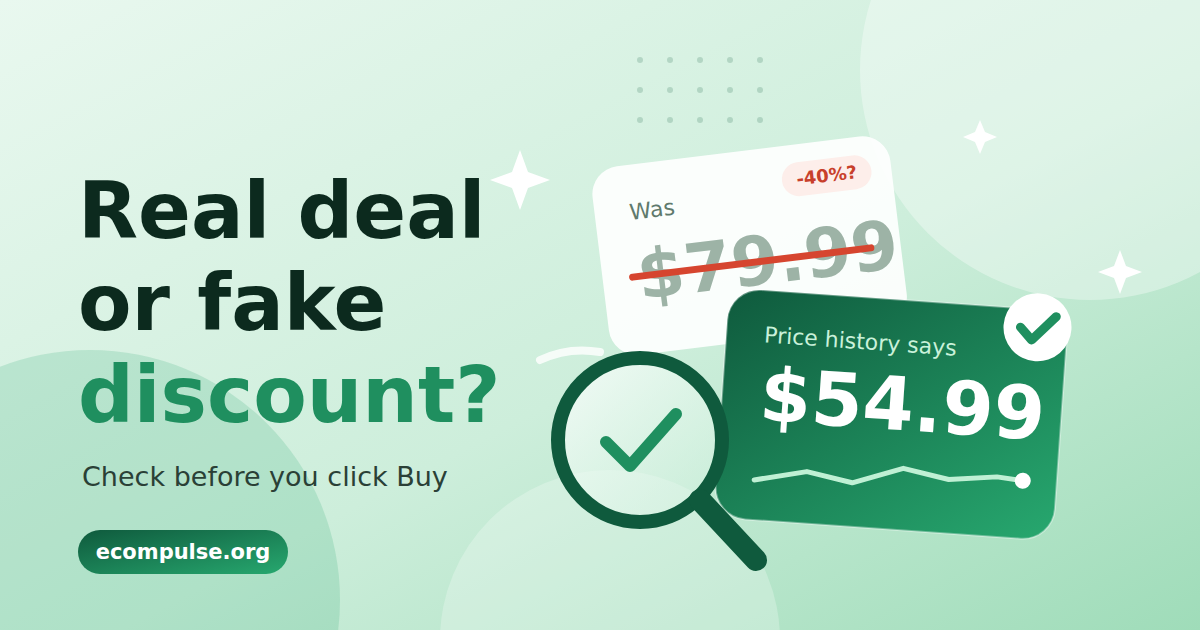
Amazon has real bargains every day. It also has plenty of products whose “savings” were designed to make you click faster. Telling them apart takes a few habits, not special skills.
Why fake discounts work so well
Shoppers rarely remember what a product cost last month. Sellers know this, so they anchor your attention on a high reference price and then show a percentage off. Your brain compares the new price to the anchor, not to the real market price.
The tactic is common on marketplace listings, where third-party sellers can raise a list price for a while and then “discount” it back to where it always was. The fix is simple: stop judging the deal by the badge, and judge it by the price history.
Check the price history first
This is the single most useful habit. Free price trackers such as Keepa and CamelCamelCamel show how an Amazon price has moved over weeks and months. Paste the product link or ASIN and look at three things:
- The 90-day low. If today’s price is at or near it, the deal is solid. If it was cheaper last month, wait.
- The usual range. A flat line with tiny wiggles means the “sale” is just the normal price.
- Sudden spikes before a sale. A price that jumps up days before an event, then “drops,” is a classic warning sign.
Pro tip: set a price alert at your target price. Let the deal come to you instead of chasing every badge.
Decode the crossed-out price
The strikethrough number is a reference price. It might be the manufacturer’s suggested price, an old price, or a figure the seller entered. None of these guarantee that shoppers ever paid it.
Red flags
- Discounts of 60% to 80% on everyday items
- A list price far above any other store
- Unknown brand with a “limited time” banner
Green flags
- Price matches or beats its 90-day low
- Known brand with steady, recent sales history
- Other retailers list a similar higher price
Lightning Deals, coupons and badges
Lightning Deals and Deals of the Day are genuine time-limited offers, but they are only as good as the price they start from. Always run the price-history check, then decide.
Clip-on coupons are easy to miss. A “Save 15% with coupon” box does not change the listed price until you tick it, so confirm the final price at checkout. Also be careful with labels like “Limited time deal” or “Best seller.” They describe sales activity, not value.
Watch out: a deal that ends in a countdown is meant to rush you. Real bargains still look good after you take 60 seconds to check them.
Check the seller and the reviews
A great price from a weak seller is not a great deal. Scroll to “Sold by” and “Ships from.” Items fulfilled by Amazon generally have easier returns, while unknown marketplace sellers can mean slower shipping and harder refunds.
Then read the reviews with a critical eye:
- Look for a sudden burst of five-star reviews in a few days.
- Read the three-star reviews first, since they tend to be the most balanced.
- Check that reviews actually describe the product on the page. Some listings merge unrelated products and inherit their ratings.
Compare with other stores
Open the same product at two or three other retailers. If Amazon’s “sale” price is the same as everyone else’s everyday price, the discount is cosmetic. If it is clearly lower, you have found a real saving. A quick search by model number is enough.
Time your purchase
Big sale events, including Prime Big Deal Days in the fall, Black Friday, and Cyber Monday, often bring real price cuts on electronics, home, and kitchen products. Seasonal items also dip when the season ends. Even during these events, verify each price, because event banners attract inflated list prices too.
Your 60-second real-deal checklist
- Is today’s price at or near the 90-day low on a price tracker?
- Does another retailer sell it for a similar or higher price?
- Is the seller trustworthy, with a clear return policy?
- Do the reviews look natural and describe this exact product?
- Did you confirm the final price after coupons and shipping?
If you can tick four out of five, buy with confidence. If not, set an alert and wait.
Frequently asked questions
How do I know if an Amazon discount is real?
Check the price history with a tracker like Keepa or CamelCamelCamel. If the price is not lower than what the item sold for recently, the discount is not real, whatever the badge says.
What does the crossed-out price mean?
It is a reference price, such as a list price or an earlier price. It does not always reflect what customers actually paid, so do not rely on it alone.
Are Lightning Deals worth it?
Sometimes. They are real limited-time offers, but the value depends on the starting price. Compare the deal price with the history before buying.
When is the best time to buy on Amazon?
Major events like Prime Big Deal Days, Black Friday, and Cyber Monday often bring genuine drops. Verify each price against its history anyway.
Shop smarter with EcomPulse
Get practical ecommerce tips, deal-hunting guides, and shopping insights straight from our team.
Explore more on EcomPulsePrices and offers on Amazon change quickly. Always confirm the current price and terms on the product page before you buy.