
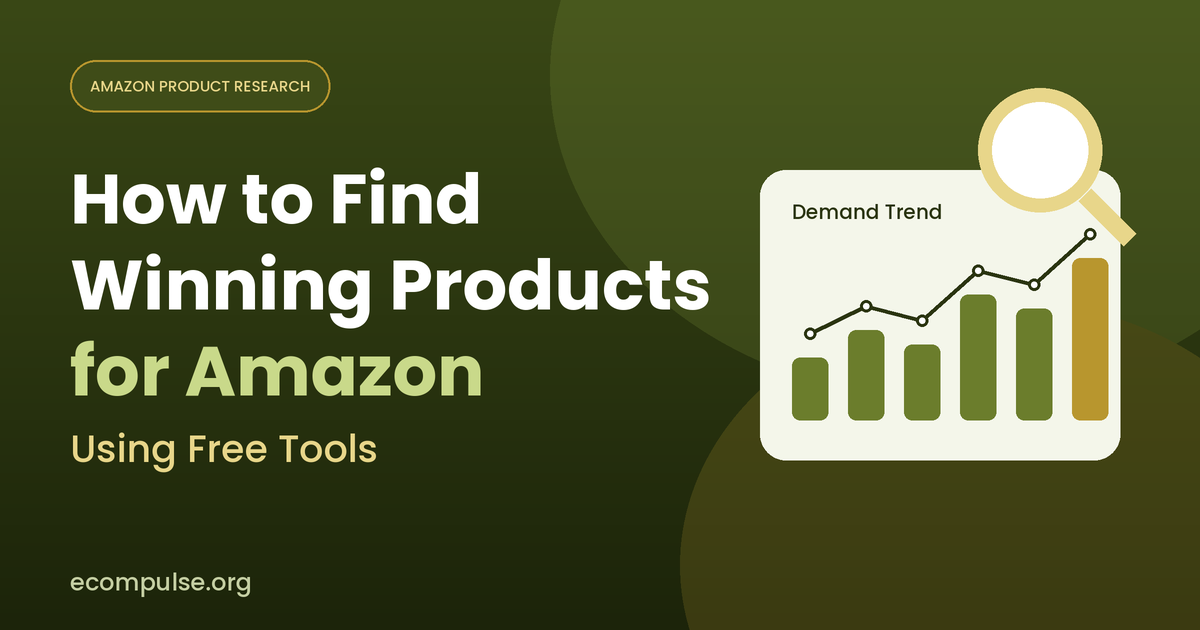
How to Find Winning Products for Amazon Using Free Tools

Finding a winning product for Amazon is the most important decision you will make as a seller. Pick well and everything gets easier: ads convert, reviews come faster and margins stay healthy. Pick poorly and you are stuck with dead inventory.
The good news? You do not need an expensive subscription to do Amazon product research. In this guide you will learn a simple, repeatable process using only free tools.
In this guide
What Makes a Product “Winning” on Amazon?
A winning product is not simply a trending one. It balances five things:
- Steady demand: people search for it all year, or in a predictable season.
- Beatable competition: top listings have weaknesses you can improve on.
- Healthy margin: profit remains after product cost, shipping and Amazon fees.
- Differentiation potential: you can improve quality, bundle, or design.
- Low risk: small, light, durable, and not heavily regulated or fragile.
Best Free Tools for Amazon Product Research
| Tool | Best for |
|---|---|
| Amazon Best Sellers & Movers & Shakers | Spotting popular and fast-rising products by category |
| Amazon search bar (autocomplete) | Finding real buyer keywords |
| Google Trends | Checking seasonality and long-term interest |
| Google Keyword Planner | Estimating search volume (free with an Ads account) |
| Keepa (free features) | Price and sales-rank history |
| Free tiers of Helium 10 / Jungle Scout | Basic keyword and sales estimates, profit calculators |
| Amazon FBA Revenue Calculator | Estimating fees and profit |
| TikTok Creative Center & Pinterest Trends | Catching products before they peak |
| Reddit & Quora | Finding unsolved customer problems |
| Alibaba / AliExpress | Estimating supplier cost |
Free plans change often, so check each tool’s current limits.
7-Step Process to Find a Winning Product
Step 1: Start With Amazon Best Sellers and Movers & Shakers
Browse categories that fit FBA: home, kitchen, pets, fitness, office and baby. Note products that appear on Movers & Shakers repeatedly, because this signals rising demand rather than a one-day spike.
Step 2: Mine Amazon Autocomplete for Buyer Keywords
Type a product idea into the Amazon search bar and see what it suggests. Add letters (a, b, c…) after the keyword to uncover long-tail phrases. These are the exact terms buyers use, so save them for your listing later.
Step 3: Validate Demand With Google Trends
Compare your product to related terms. Look for a flat or rising line over 5 years. Avoid sharp one-time spikes, which usually mean fads. Seasonal curves are fine if you plan your inventory around them.
Step 4: Analyze Competition Manually
Search your keyword and open the top 10 listings. Check:
- Review counts and star ratings (4.0–4.4 stars often signals room to improve).
- Photo and A+ content quality.
- Whether many sellers have strong, established brands.
- Negative reviews: they list exactly what customers want fixed.
Step 5: Check Price and Rank History With Keepa
Open the product’s Keepa chart. A stable sales rank and consistent pricing suggest reliable demand. Wild price drops can indicate a price war.
Step 6: Estimate Profit Before You Fall in Love
Use the free Amazon FBA Revenue Calculator and a supplier quote to estimate landed cost + FBA fees + referral fee + ad spend. Many sellers aim for products with enough margin to survive ads and returns, but set your own target.
Step 7: Find Your Angle
Read 1–3 star reviews of competitors and list the top complaints. Your product, bundle or packaging should solve them. This is your unique selling proposition.
Pro tip: Search “your product + problem” on Reddit. Threads full of complaints often reveal product gaps that no tool will show you.
Winning Product Checklist
- ✅ Consistent or predictably seasonal search interest
- ✅ Multiple sellers making sales, but not all dominated by big brands
- ✅ Competitor weaknesses in reviews you can fix
- ✅ Small, lightweight, durable (lower shipping and damage risk)
- ✅ Healthy margin after all fees
- ✅ No patent, trademark or category-approval issues
- ✅ Easy to improve, bundle or brand
Common Mistakes to Avoid
- Chasing fads: viral products can disappear before your stock arrives.
- Ignoring fees: a product that looks profitable can lose money after FBA costs.
- Trusting one data source: cross-check at least two tools.
- Skipping legal checks: search trademarks and patents before ordering.
- Copying competitors exactly: without differentiation, you compete only on price.
Want expert help with product research?
Our team handles market research, competitor analysis and demand evaluation so you can launch with confidence.
Explore Our Services Book a Free CallFrequently Asked Questions
Can I find winning Amazon products without paid tools?
Yes. Google Trends, Amazon Best Sellers, autocomplete, Keepa’s free features and social platforms provide enough data to validate demand and competition.
How many products should I research before choosing one?
Shortlist 20–30 ideas, validate 5–10 in depth, then launch with the one offering the best mix of demand, margin and differentiation.
Are free tools accurate?
They provide directional estimates, not exact figures. Always cross-check before investing in inventory.
What is a good price range for a first product?
Many beginners prefer mid-priced items, since very cheap products leave thin margins and expensive ones raise your risk. Test your own numbers in the revenue calculator.
Final Thoughts
Finding a winning product is a research process, not luck. Combine demand data, competitor analysis and customer feedback, and you can make confident decisions with free Amazon product research tools. Pick one category, shortlist ten ideas and run them through the seven steps above.